Gentle postpartum exercises: rebuilding your core and pelvic floor.
After birth, the deep core and pelvic floor don't switch back on by themselves — they have to be retrained. Here's the four-step starting routine we teach, and how to know you're ready for it.

Start with four simple steps, in order: belly breathing, pelvic floor squeezes with full relaxation, pelvic tilts and glute bridges, daily. Breathing and pelvic floor work can usually begin days after an uncomplicated vaginal birth; structured exercise waits for your provider's clearance around six weeks, later after a C-section. Sharp pain, pelvic heaviness or bulging, worse leaking or restarted bleeding means stop and get assessed.
After nine months of pregnancy and a delivery, the deep core and pelvic floor don't simply switch back on — they have to be retrained, gently and in the right order. The good news: the starting point is not planks or crunches. It's four quiet movements you can do on a bedroom floor.
First: when is it safe to start?
Gentle breathing and pelvic floor activation can usually begin within days of an uncomplicated vaginal delivery — and most providers clear structured exercise at the postpartum checkup around six weeks, later for a C-section or complicated delivery. Clear it with your provider first; ACOG's guidance on exercise after pregnancy is the standard reference.
Soreness is normal when restarting. Sharp pain, heaviness or bulging in the pelvic floor, leaking that worsens with exercise, or bleeding that restarts are signals to stop and get assessed — they usually mean the progression is too fast, not that exercise is wrong. For the bigger picture of what's changed and why, start with our guide to postpartum recovery.
The four-step starting routine
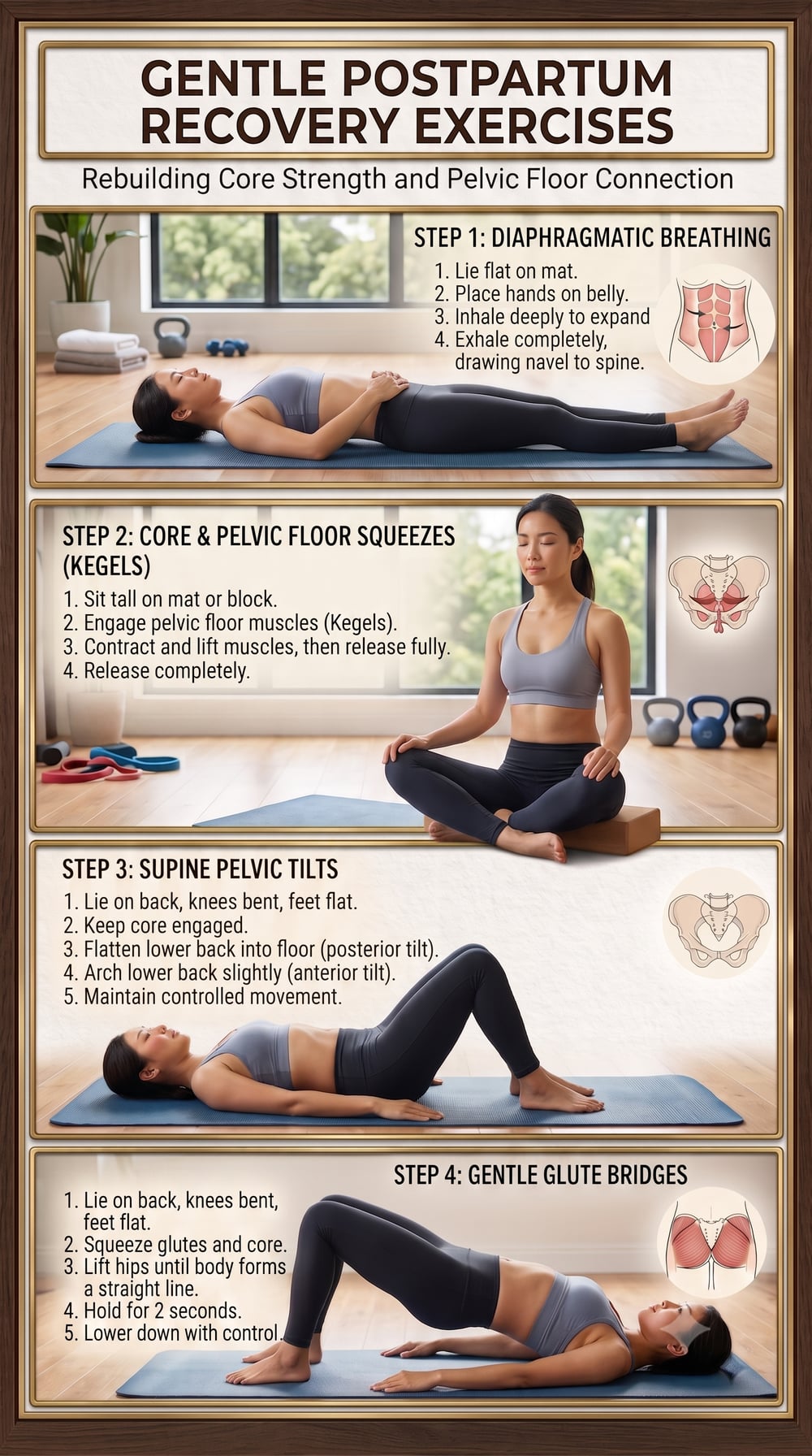
These are the same four steps in the guide below — in order, because each one builds the foundation for the next.
- Diaphragmatic breathing. Lie flat, hands on your belly. Inhale to expand the belly, exhale fully and draw the navel toward the spine. This reconnects the diaphragm, deep abdominals and pelvic floor — the pressure system everything else depends on.
- Core & pelvic floor squeezes (Kegels). Sitting tall, contract and lift the pelvic floor, then — just as important — release it completely. Full relaxation is half the exercise; a pelvic floor that only knows how to clench causes its own problems.
- Supine pelvic tilts. On your back with knees bent, flatten the low back into the floor, then arch it slightly, moving slowly with the core engaged. This wakes up the deep abdominals and gently mobilizes a low back that spent months compensating.
- Gentle glute bridges. Squeeze the glutes and lift the hips into a straight line, hold two seconds, lower with control. The glutes are the pelvis's main stabilizers — rebuilding them takes pressure off the low back and pelvic floor.
Start with a few minutes daily rather than a long session twice a week. Consistency, not intensity, is what re-establishes the connection.
The postpartum core isn't weak so much as disconnected. The first job is restoring the signal — breath, floor, deep abdominals — and strength follows faster than most people expect.
Why does my back hurt more now than during pregnancy?
Feeding positions, carrying a car seat, lifting a growing baby off the floor dozens of times a day — the postpartum months load the spine harder than pregnancy did, right when the deep core is at its weakest. That mismatch is why back pain often peaks after delivery.
The routine above shrinks the gap from the inside. The other half is mechanical — restoring the joint motion the pelvis and mid-back lost across pregnancy, which is where hands-on care earns its keep. If you had care during pregnancy, this is the natural continuation of the prenatal care many patients start before delivery.
Postpartum visits at The Spine Studio are built around real life: bring the baby, feed mid-visit if you need to, and we'll fit the exam and treatment around it. The assessment checks your pelvic alignment, core activation and the movement patterns feeding and carrying have built — then the exercise plan gets tailored to where you actually are.
When exercises alone aren't enough
If leaking, heaviness, or a doming ridge down the midline of your belly (diastasis recti) persists past the early months, or pain is steering your daily life, get assessed rather than pushing through the same routine harder. Progress that has stalled usually needs a different input — not more repetitions of the same one.
Rebuild from the foundation up, with a plan matched to your delivery and your timeline.
Frequently asked questions
- When can I start exercising after giving birth?
- Gentle breathing work and pelvic floor activation can usually start within days of an uncomplicated vaginal delivery. Structured exercise typically waits for your provider's clearance at the postpartum checkup around six weeks — longer after a C-section or complicated delivery. Always clear it with your provider first, then progress gradually from breathing and activation work toward load.
- What are the best exercises to start postpartum recovery?
- Start with four foundations, in order: diaphragmatic breathing to reconnect the deep core, pelvic floor squeezes with full relaxation between them, supine pelvic tilts to wake up the deep abdominals, and gentle glute bridges to rebuild the pelvis's main stabilizers. A few minutes daily beats a long session twice a week.
- Why does my back hurt so much after having a baby?
- The postpartum months often load the spine harder than pregnancy did — feeding positions, carrying a car seat, and lifting the baby dozens of times a day — right when the deep core is at its weakest. Retraining the core shrinks that gap, and restoring the joint motion the pelvis and mid-back lost during pregnancy handles the mechanical half.
- What are signs I should stop and get assessed?
- Sharp pain, a feeling of heaviness or bulging in the pelvic floor, leaking that worsens with exercise, bleeding that restarts, or a persistent doming ridge down the midline of the belly. These usually mean the progression is moving faster than the tissue is ready for — a proper assessment sorts out what to change.