Cervicogenic vs. tension headache: is your neck the cause?
Three headache types get treated as one — and the wrong fix gives no relief. How to tell cervicogenic, tension and migraine apart, what to try at home, and how long neck-driven headaches take to resolve.

There is a sentence I hear in my exam room almost weekly: "I have had a headache every Wednesday for a year." By the time someone comes to a chiropractor for headaches, they have usually been told by primary care that it is "tension" and to manage with over-the-counter meds. Sometimes that works. Other times it does not — because three very different headache types get lumped under the same umbrella, and the treatment that fixes one does nothing for another.
How to tell which headache you have
Before any treatment makes sense, you have to name the problem correctly. Three patterns account for the overwhelming majority of recurring headaches we see, and each has a fingerprint you can usually spot at home.
- Cervicogenic. One-sided, starts at the base of the skull and pulls forward over the eye, and predictably worsens when you turn or hold your neck in one position.
- Tension-type. Both sides, a band or vise of pressure around the head, mild-to-moderate, builds gradually through the day, and does not change much with neck movement.
- Migraine. Throbbing, often with nausea, light and sound sensitivity, sometimes a visual aura beforehand — a neurological event, not a muscular one.
The fastest home test is movement: cervicogenic headaches reliably flare when your neck moves; tension headaches mostly ignore it; migraines run on their own clock. That single distinction sorts most people into the right lane.
A few more quick discriminators help when the picture is muddy. Cervicogenic pain is almost always one-sided and stays on the same side episode after episode; tension pain wraps both temples; migraine can switch sides but brings nausea or light sensitivity that the other two do not. If pressing firmly at the base of your skull reproduces the exact headache, that points hard at the neck. And if your headaches cluster around long screen days and ease on the weekend, the mechanical pattern is doing the talking.
Type 1: Cervicogenic headache
This is the one we are best positioned to help. The pain originates from the upper cervical spine (C1-C3) and refers up into the head. The hallmarks:
- Pain starts at the base of the skull and radiates forward, often over one side
- It is provoked by neck movement or sustained postures
- Pressing on certain points at the upper neck reproduces the headache
- There is usually limited range of motion in cervical rotation
If you have desk-job posture and recurrent one-sided headaches, this is almost certainly what is happening. The same forward-head mechanics that drive tech neck load the upper cervical joints all day, and that constant load is what refers pain into the head. The international classification of headache disorders defines cervicogenic clearly — Harvard Health has a useful primer on differentiating headache types.
Type 2: Tension-type headache
The most common headache type globally. Pain is usually bilateral, described as a band or pressure around the head, mild-to-moderate intensity, no nausea, no light sensitivity. It builds gradually over the day.
Tension headaches have overlap with cervicogenic — both involve neck and shoulder muscle tightness, and both respond to the same upper-trap and sub-occipital work. The difference is the pain pattern: bilateral and band-like versus one-sided and pulling forward. When the tightness is severe enough to knot up, it can behave like the muscle spasms we treat elsewhere in the body, just higher up the chain.
A useful test: cervicogenic headaches reliably worsen with neck movement. Tension headaches don't change much with what your neck is doing.
Type 3: Migraine
Migraines are a neurological event, not a muscular one. They typically have:
- Throbbing, often one-sided pain (but can switch sides between episodes)
- Nausea, often with vomiting
- Sensitivity to light and sound
- Sometimes preceded by aura (visual or sensory disturbance)
- Lasts 4-72 hours and is disabling
Migraines need a neurologist's involvement. We can sometimes help reduce migraine frequency when there is a clear muscular trigger pattern, but we are not the front line of migraine care. The Mayo Clinic's migraine page is the right starting point.
How to relieve a tension or cervicogenic headache at home
None of this replaces a diagnosis, but if your pattern points to neck-driven pain, these moves take pressure off the structures actually generating it. Do them gently — if anything sharply increases the headache, stop.
Sub-Occipital Release
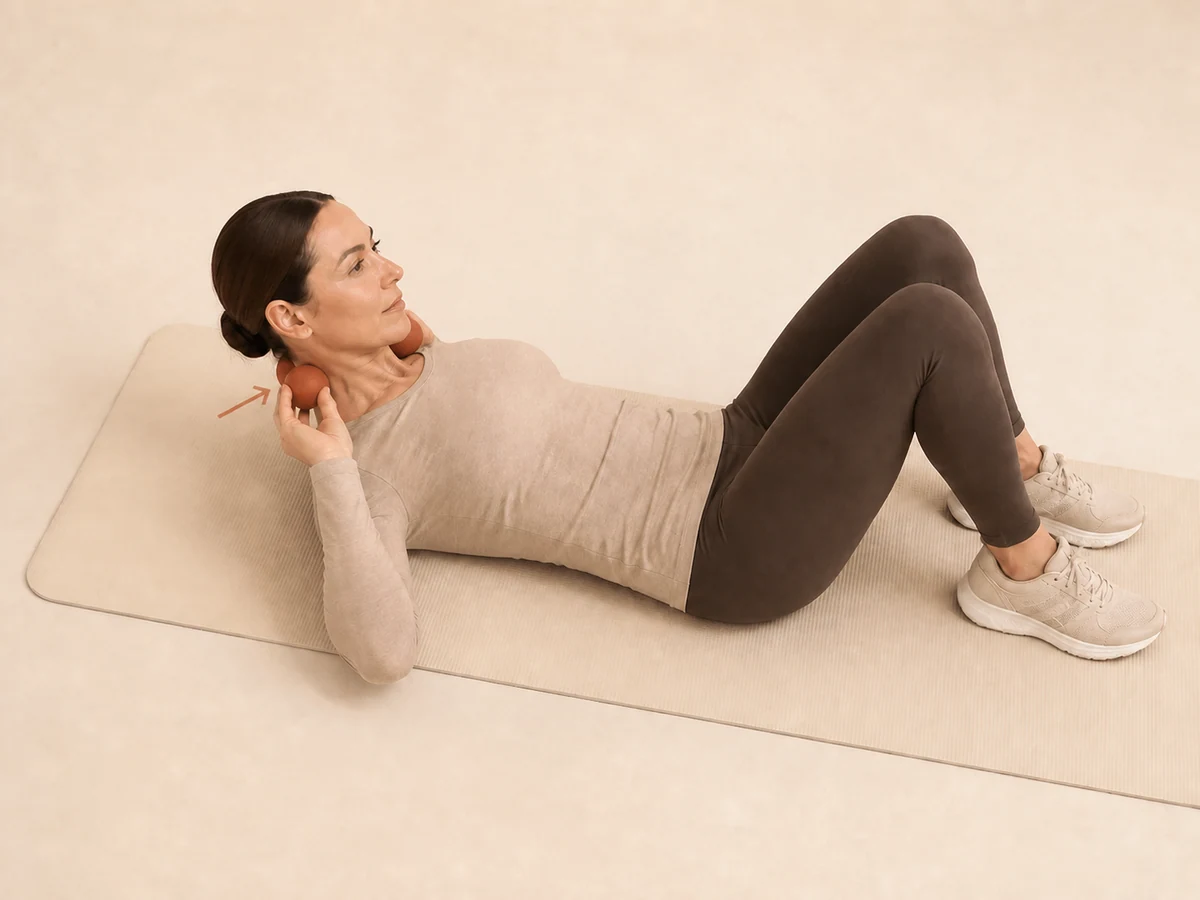
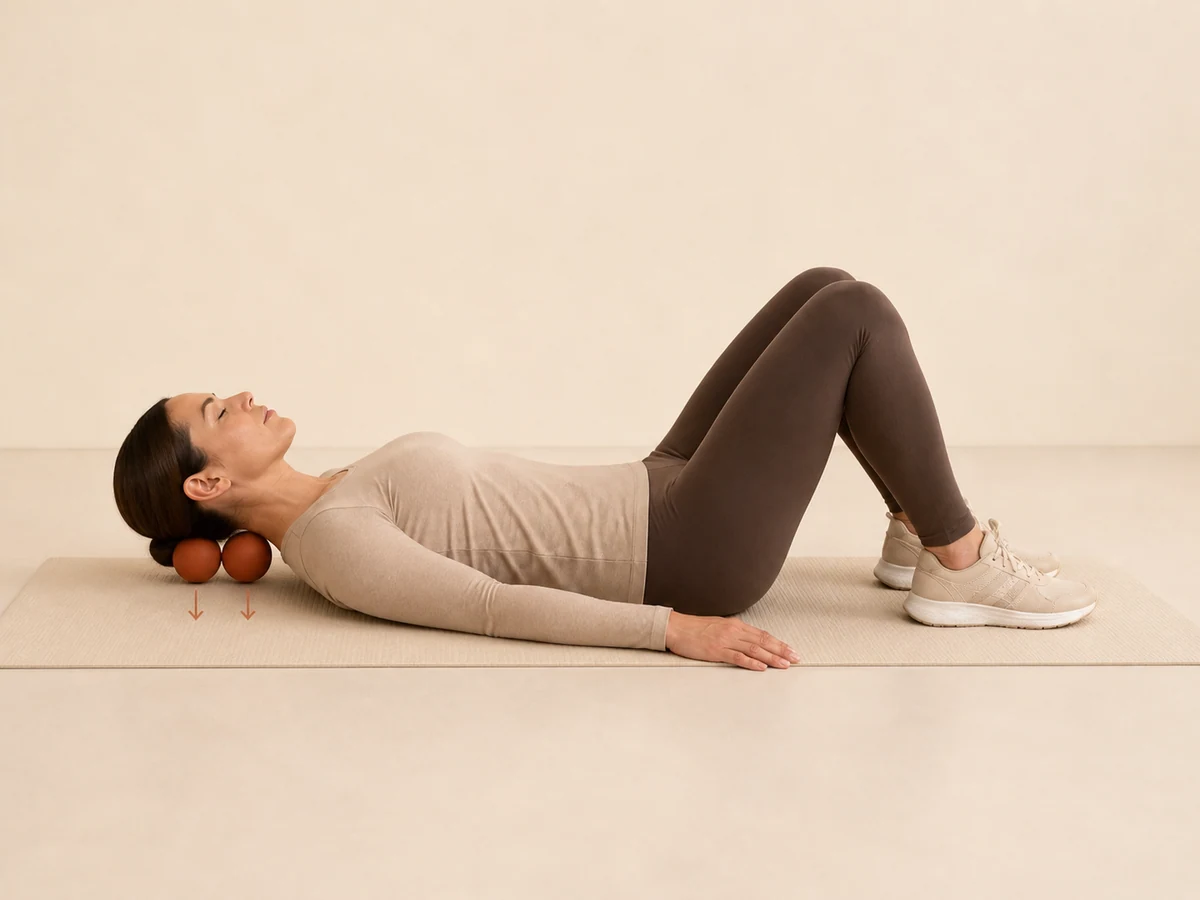
Lie on your back and place two tennis balls (or a peanut-shaped roller) just under the ridge at the base of your skull, one on each side of the spine. Rest your head into them and breathe. This is the same muscle group we target with acupuncture in the clinic.
Hold 2–3 minChin Tucks
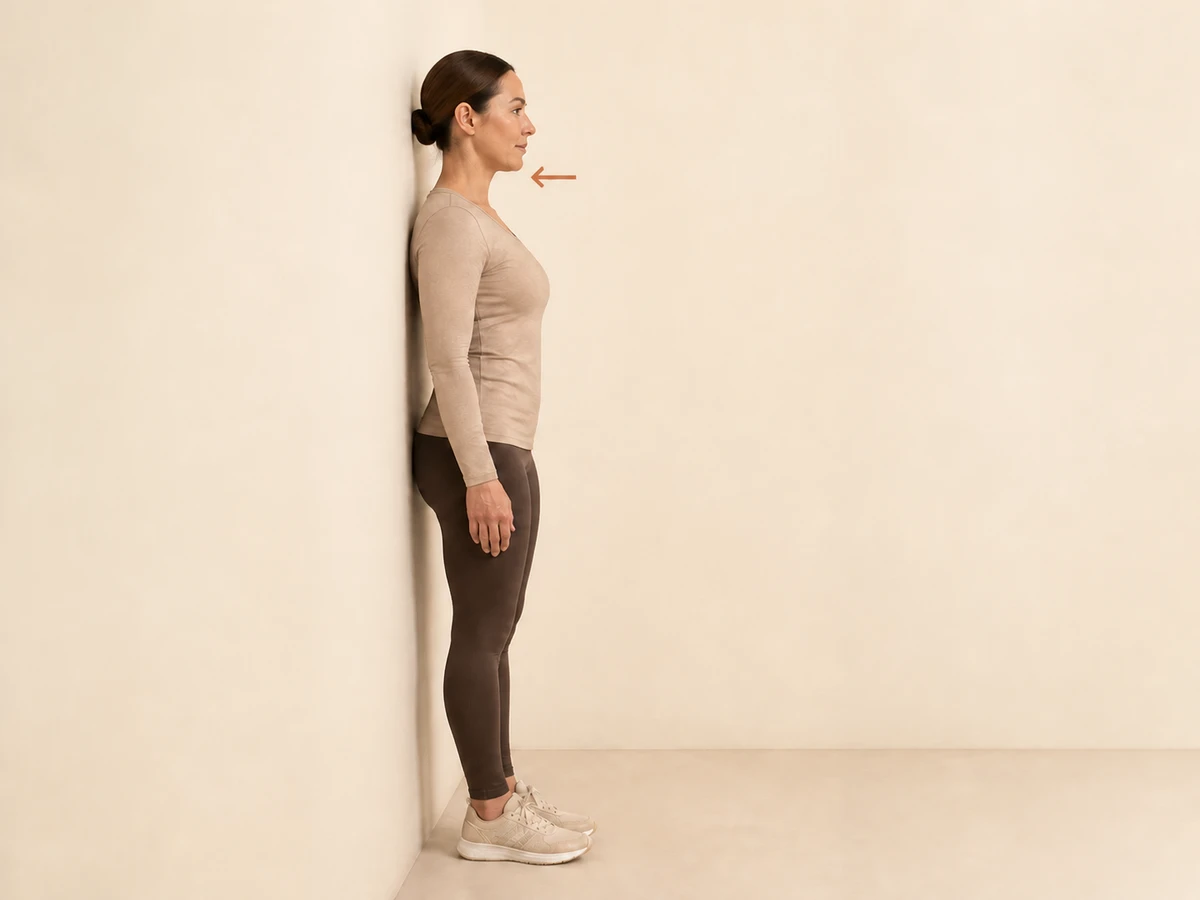
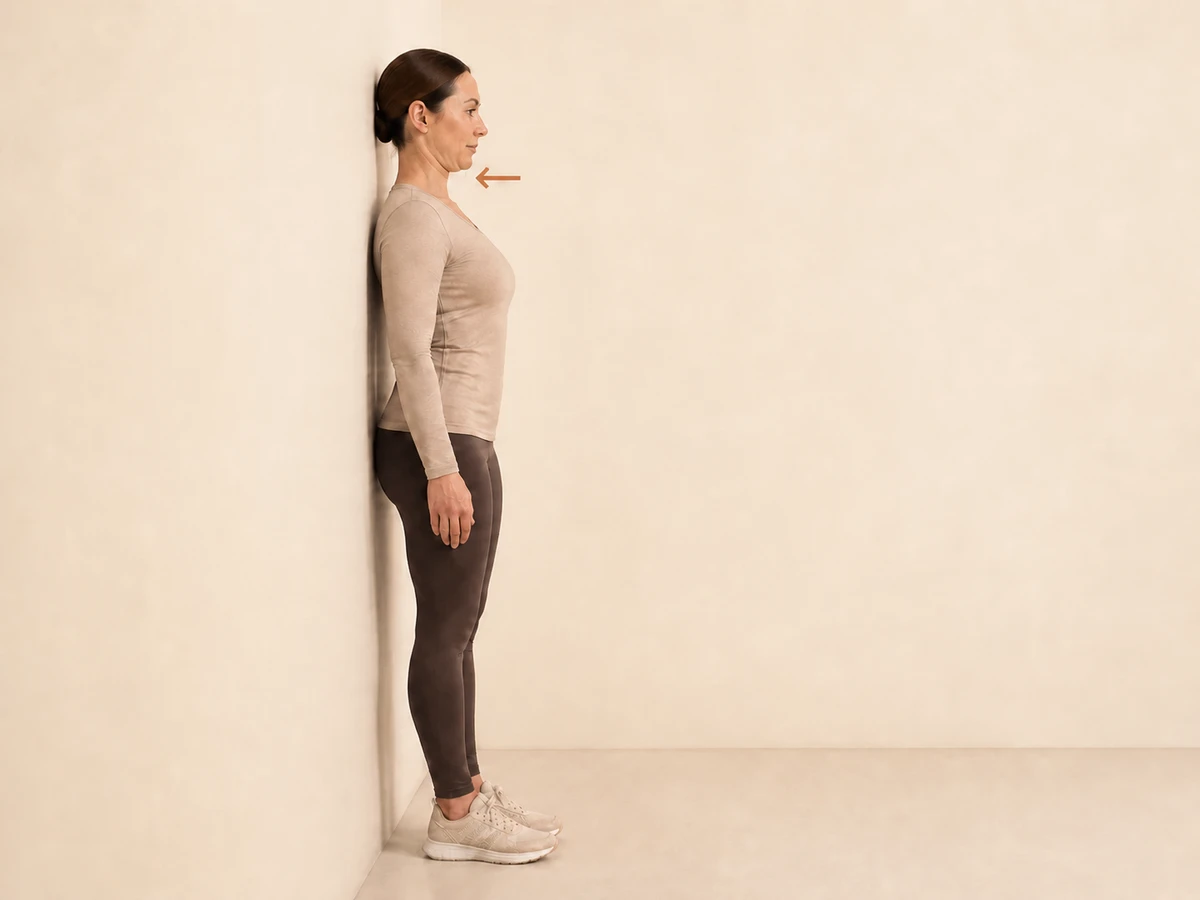
Sitting tall, draw your chin straight back as if making a double chin, hold, then release. This retrains the deep neck flexors that forward-head posture switches off.
10 reps/Hold 5sUpper-Trap & Levator Stretch
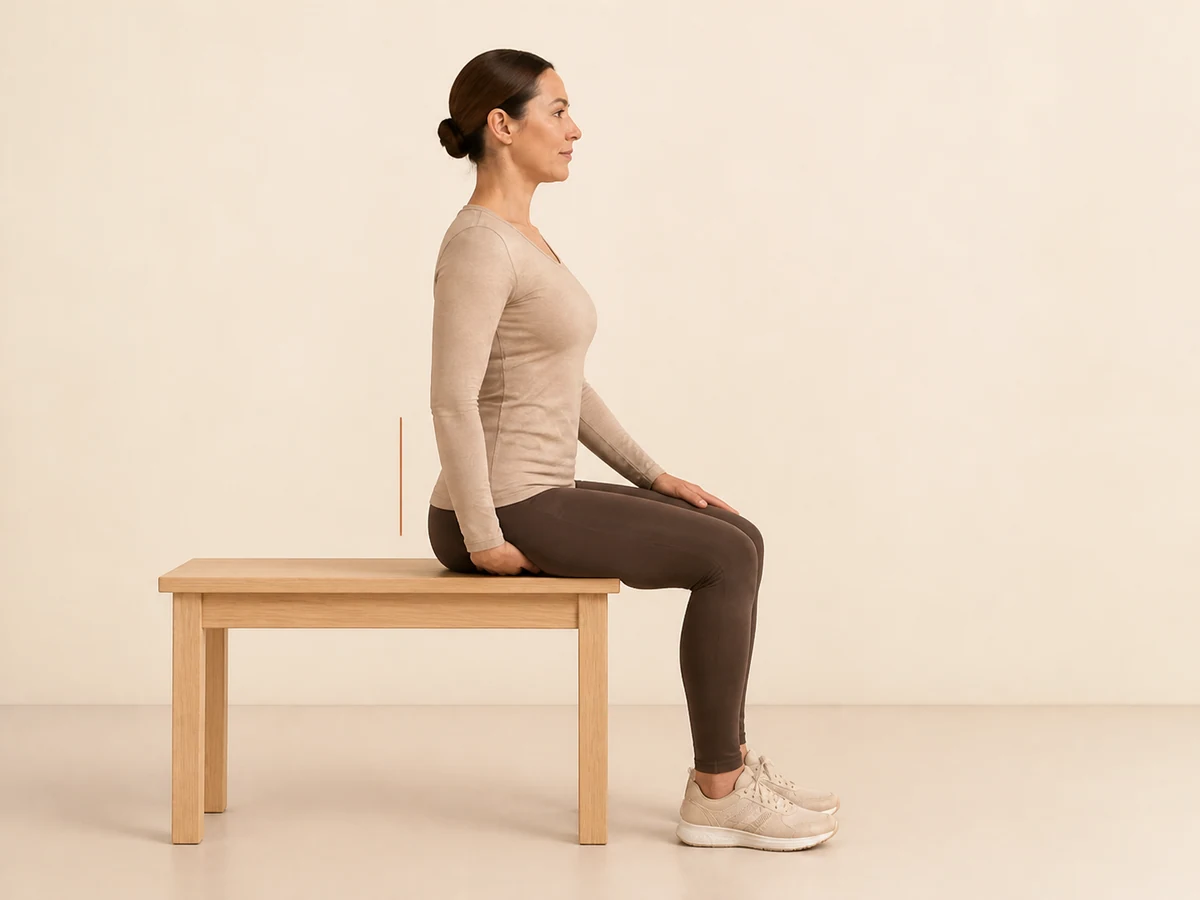
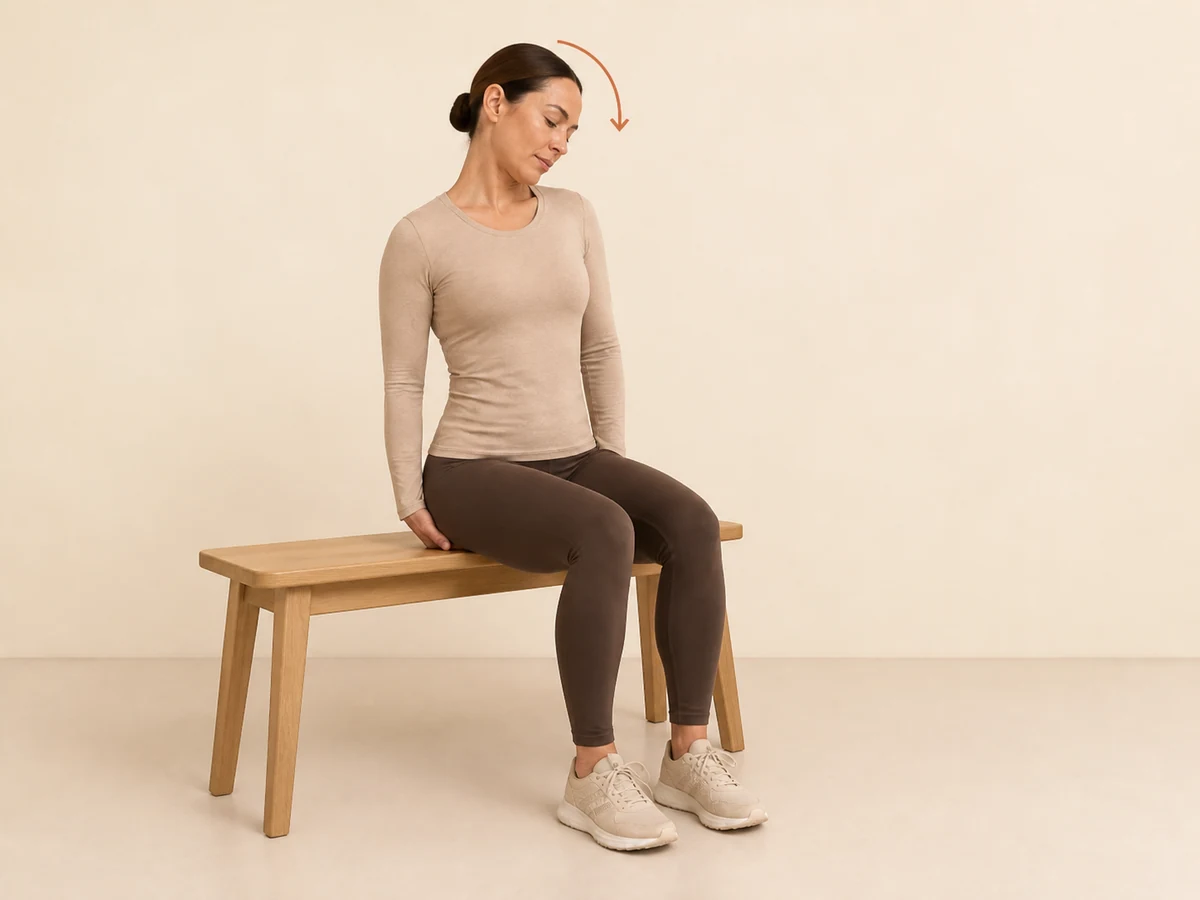
Sit tall and anchor one shoulder by sitting on that hand. Gently tilt your head down and away, bringing your ear toward the opposite shoulder until you feel a stretch down the side of the neck. Ease off if it sharpens the headache.
30s each side- Heat, not ice. Ten to fifteen minutes of moist heat across the upper neck and shoulders relaxes the muscles that refer pain forward. Ice is for acute injury; this is muscular tension.
- Posture breaks. Every thirty minutes at a desk, look up, roll the shoulders back, and reset your screen to eye level. The trigger is sustained load, so interrupting it is half the treatment.
If these help but the headaches keep returning, that is useful information — it confirms the neck is involved and that the underlying mechanics still need correcting.
What we do for cervicogenic headaches
Conservative care is very effective for this type. A typical course at The Spine Studio:
- Precision adjustments at the upper cervical segments — restoring motion is the single most impactful intervention
- Acupuncture into the sub-occipital muscles — the small muscles at the base of the skull that refer pain forward over the eye. Our clinical acupuncture is performed by an acupuncture qualified chiropractor, so it is integrated with the rest of your care rather than booked as a separate errand — here’s what the evidence shows for acupuncture on headaches and migraines
- Pin & Stretch and Cupping & Scraping on the upper traps and levator scapulae
- Postural retraining — most cervicogenic headache patients have a forward-head posture component that has to be addressed for long-term resolution
An Initial Assessment is $149 and sorts out the diagnosis. Follow-up visits are $60 and include a precision adjustment plus one soft-tissue modality — Pin & Stretch, Cupping & Scraping, or Corrective Exercise Programming — at no extra charge. Standalone acupuncture is $60 per session.
How long do cervicogenic headaches take to resolve?
Most patients see meaningful reduction in headache frequency within 3-5 visits. For chronic cases of two or more years, full resolution may take 8-12 visits plus consistent home work. The timeline tracks the cause: a recent flare from a hard work week resolves quickly, while years of forward-head posture have remodeled the soft tissue and take longer to unwind. The home exercises are not optional in the chronic group — they are what holds the gains between visits.
"Worst headache of your life," sudden onset, headache with fever and stiff neck, headache after head trauma, or new headaches starting after age 50 are all reasons to seek immediate medical care, not a chiro visit. These are uncommon but they're not for us to manage.
If you're not sure which you have
That is exactly what an Initial Assessment will sort out. The exam takes about twenty minutes and is the most reliable way to differentiate. If we find it is not cervicogenic, we will tell you that and refer you appropriately. We don't treat people we can't actually help.
If your headaches are coming from your neck, that's exactly what we treat at our Cottleville clinic.
Headaches that start after a car accident are often whiplash-driven — if that's you, see our guide for an auto accident chiropractor in O'Fallon & Cottleville.
Jaw clicking or clenching alongside the headaches? The jaw and upper neck are closely linked — see how TMJ and jaw pain connect to the neck.
Get the right diagnosis first.
Frequently asked questions
- How do I know if my headache is coming from my neck?
- Neck-driven (cervicogenic) headaches usually start at the base of the skull and wrap forward, often on one side, and get worse with neck movement or sustained postures. If pressing on certain spots in your neck reproduces the headache, that points strongly to a cervical source rather than a migraine or tension headache.
- Can a chiropractor help with headaches?
- For headaches that originate in the neck, yes — restoring motion to the upper cervical joints and releasing the tight suboccipital muscles often reduces both frequency and intensity. We assess first to separate cervicogenic and tension headaches, which respond well, from migraines, which need a different plan.
- How do you relieve a tension headache from your neck?
- Short-term relief usually comes from gentle upper-neck mobility, releasing the muscles at the base of the skull, and breaking up long static postures with movement. Heat and a chin-tuck drill help many people. If the headaches keep returning, the underlying neck mechanics need treating rather than just the symptom.