Plantar fasciitis treatment: heel pain relief that lasts.
Ice and rest rarely fix stubborn heel pain. What actually drives the plantar fascia to heal — the right stretches, real loading work, and where shockwave fits.

Plantar fasciitis is the injury that humbles runners. You wake up, take your first step, and feel a sharp stab right at the inside of the heel. It eases as you warm up — and then it comes back. You ice it. You rest. You buy new shoes. The cycle repeats. After a year of this, you start to wonder if your foot is broken.
It is not broken. But the standard advice you have been following — ice, rest, stretch — is missing the part of the picture that actually matters.
What causes plantar fasciitis?
The plantar fascia is a thick band of connective tissue that runs from your heel bone to the base of your toes, supporting the arch and storing energy every time you push off. Plantar fasciitis is what happens when the load on that band outpaces its ability to repair itself.
That overload rarely comes from one thing. A sudden jump in running mileage, tight calves that rob the ankle of motion, long hours standing on hard floors, unsupportive footwear, and a stiff big toe all funnel extra strain into the same spot near the heel. According to the American Academy of Orthopaedic Surgeons, it is one of the most common causes of heel pain in adults — and most cases are mechanical, not structural.
It isn't really "-itis"
The "-itis" suffix implies inflammation. For a long time, we treated plantar fasciitis like an inflammatory problem, which is why ice and NSAIDs were the default. The current evidence is clearer: chronic plantar fasciitis is mostly a degenerative tendon problem, not an inflammatory one. The fascia at the bottom of your foot has microscopic disorganization, and your body isn't remodeling it quickly enough to keep up with the load you're putting on it.
Once you reframe heel pain as a tendon remodeling problem, the right treatments fall out almost automatically.
Ice and rest don't drive remodeling. Stretching alone doesn't either. What does drive it: graded load, applied for long enough, in a way the tissue can tolerate.
Plantar fasciitis exercises and stretches that actually help
Most people stretch the wrong way for the wrong reason. The goal is not to loosen the foot for a few minutes — it is to load the fascia and calf complex so the tissue rebuilds stronger. These are the four we hand patients most often.
Plantar Fascia Stretch
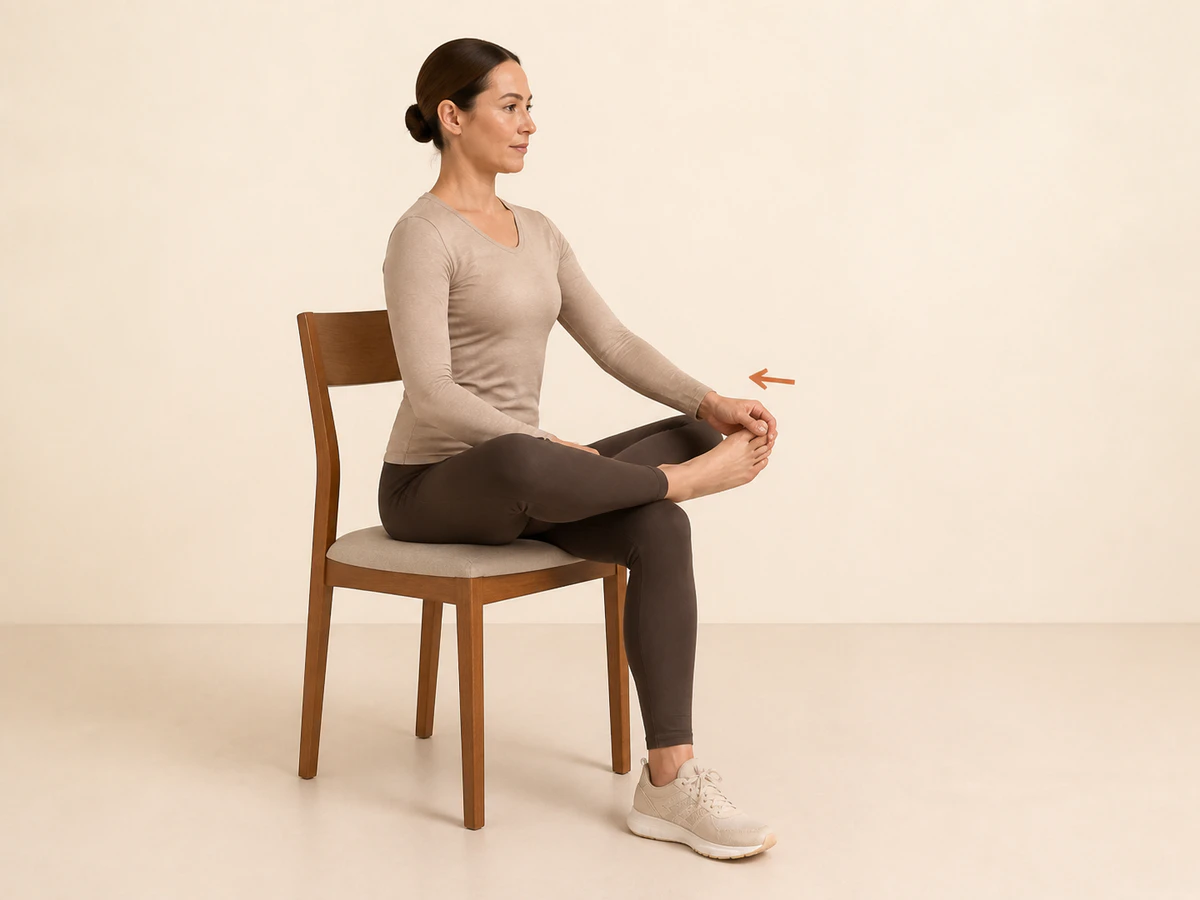
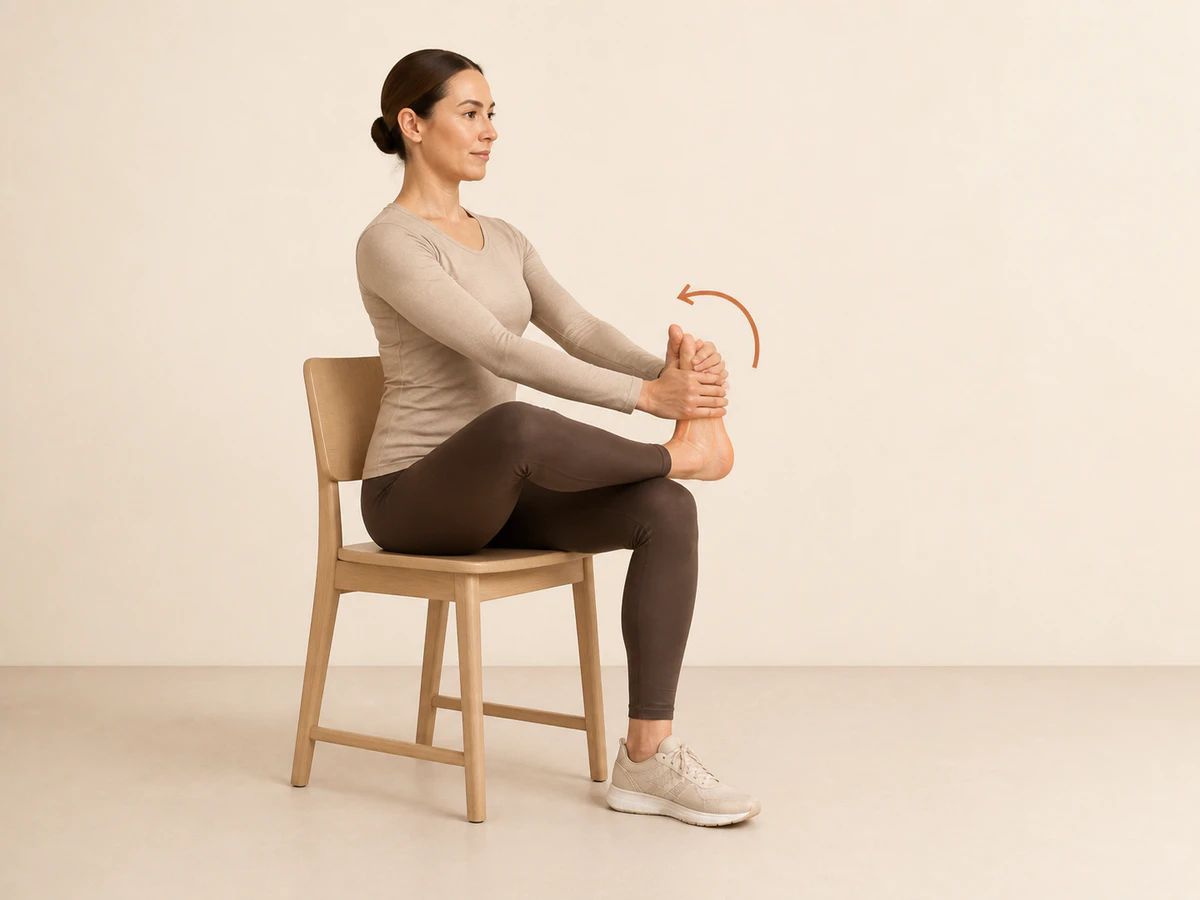
Sitting, cross the painful foot over your knee, grab the toes, and pull them back toward the shin until you feel a stretch along the arch. Do it before your first steps in the morning — the single most evidence-backed stretch for the condition.
10 reps/Hold 10sCalf Stretch at the Wall
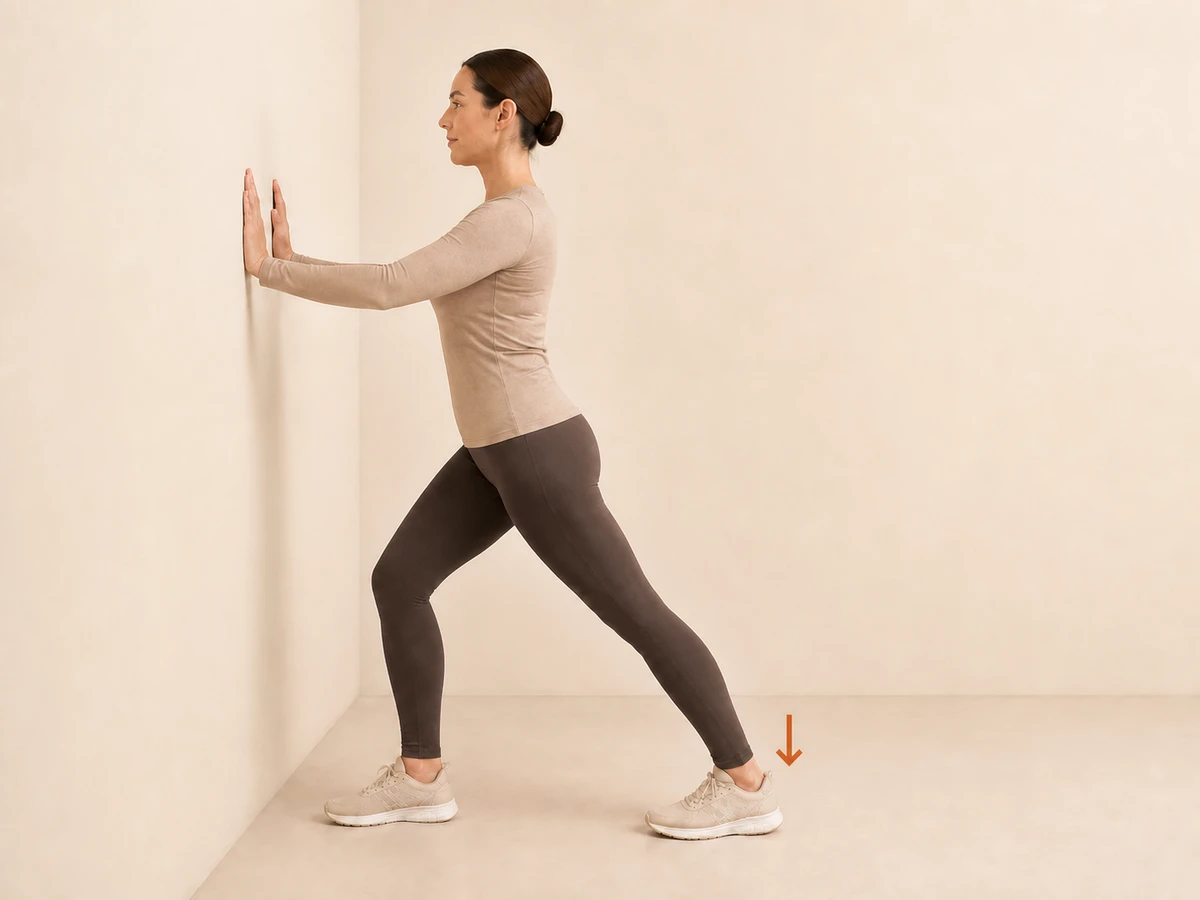
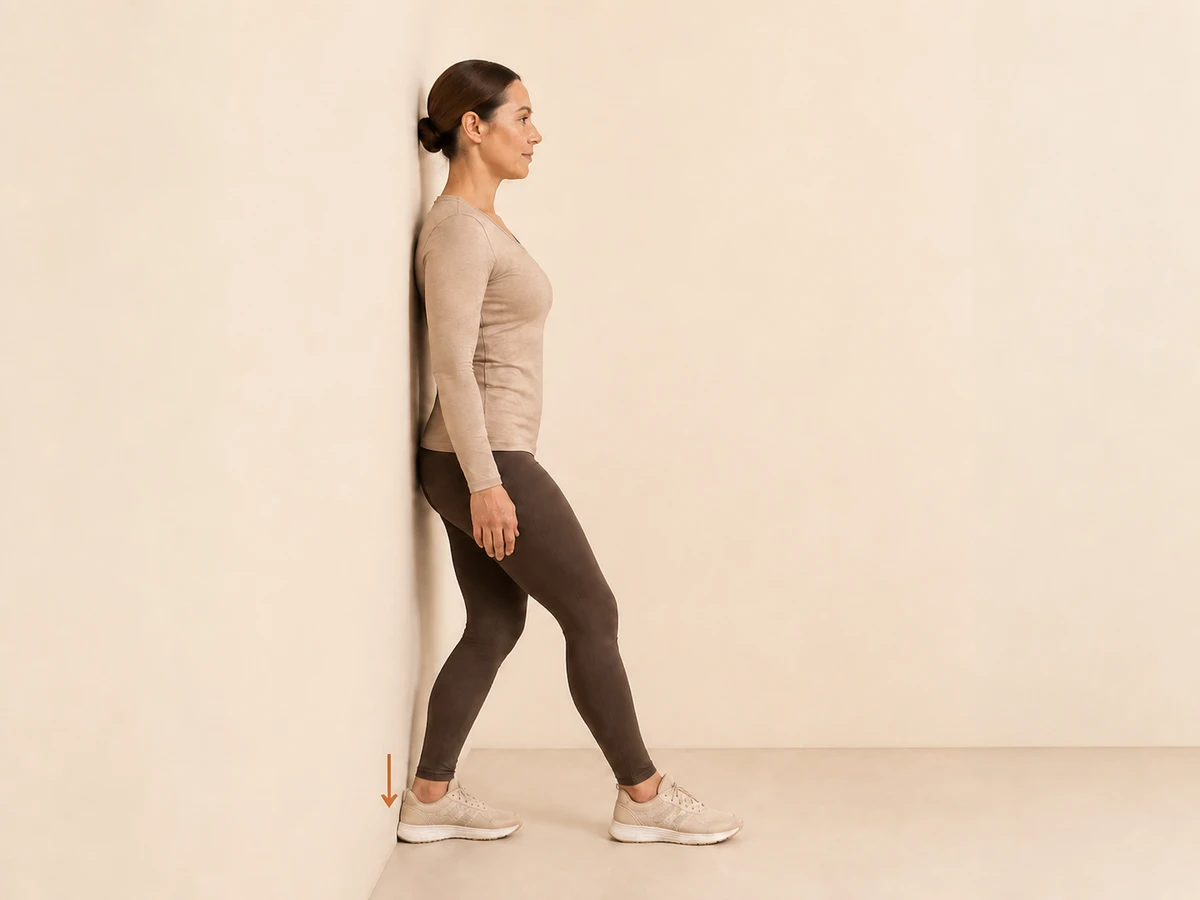
Hands on the wall, painful leg back and straight, heel down; then repeat with the knee slightly bent to catch the deeper soleus. Tight calves are the most common upstream driver, so this one earns its place.
Hold 30s eachHeel Raises Off a Step
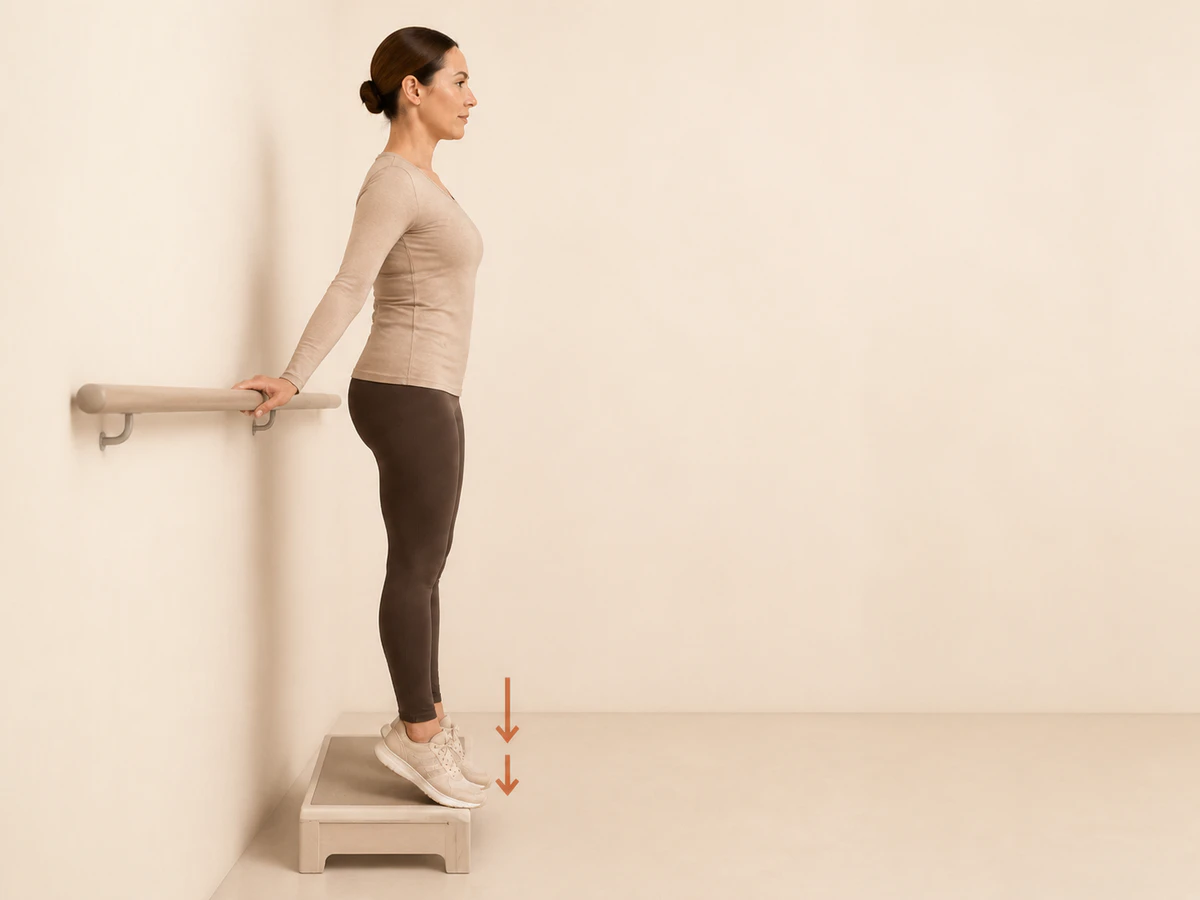
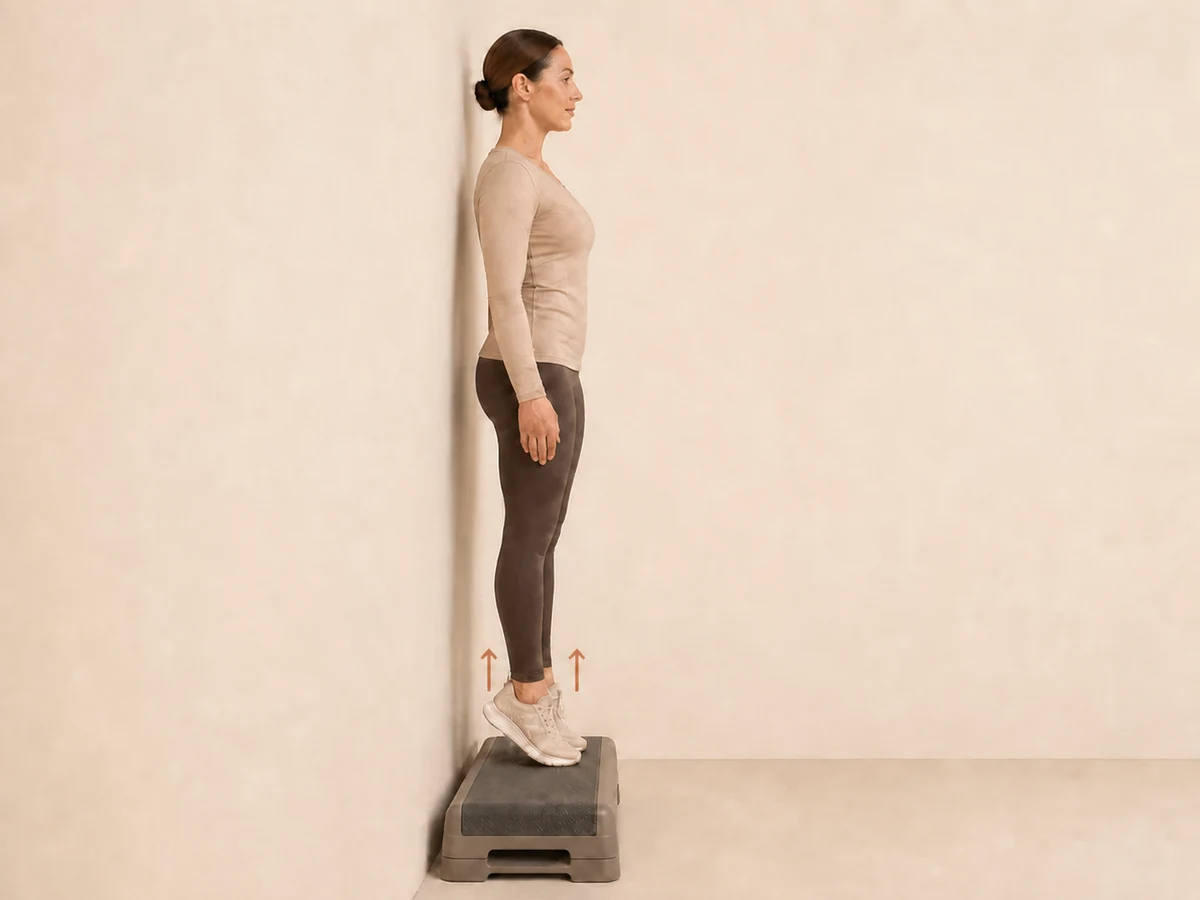
Stand on the edge of a stair, lower the heels slowly below the step, then rise. Slow tempo. This is the loading work that actually remodels the tissue — skip it and the stretches alone tend to stall.
3 sets × 15Intrinsic Foot Work
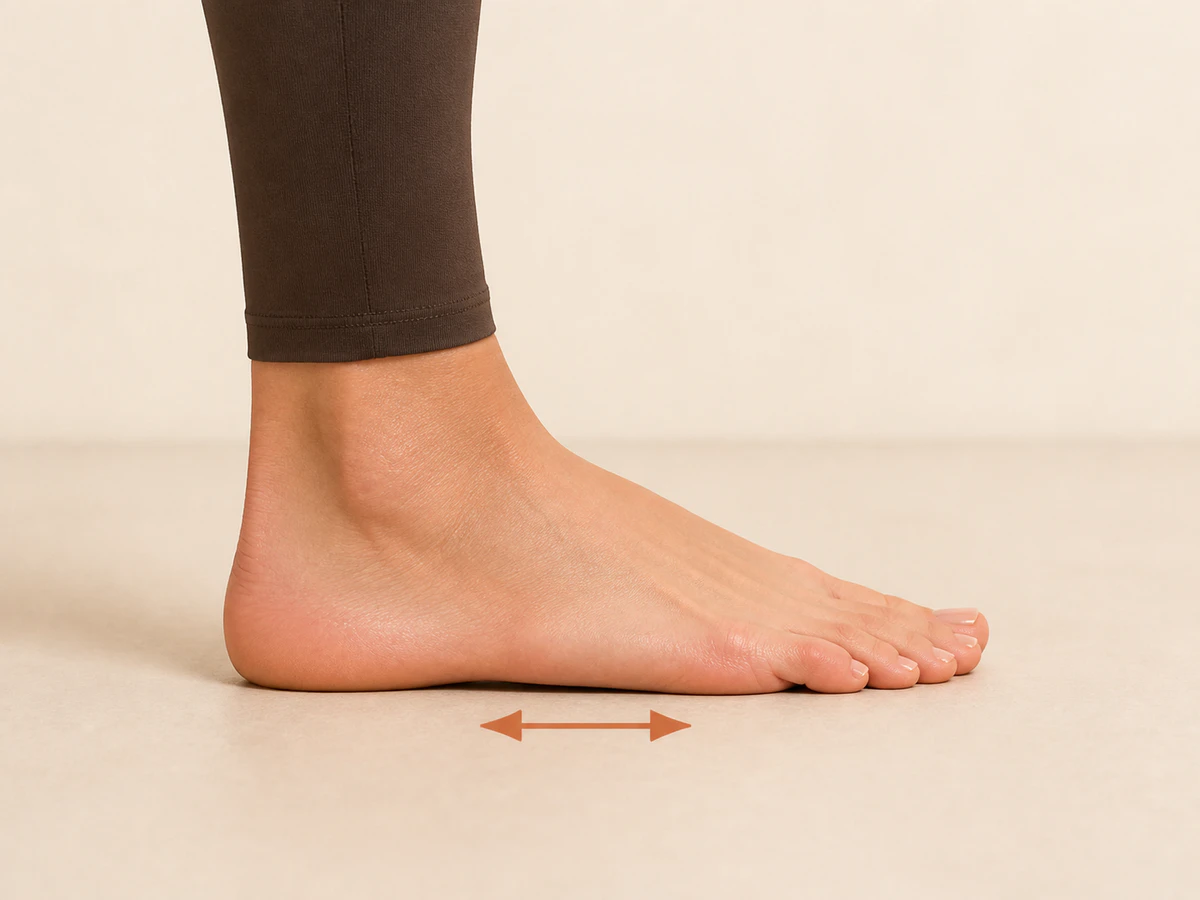
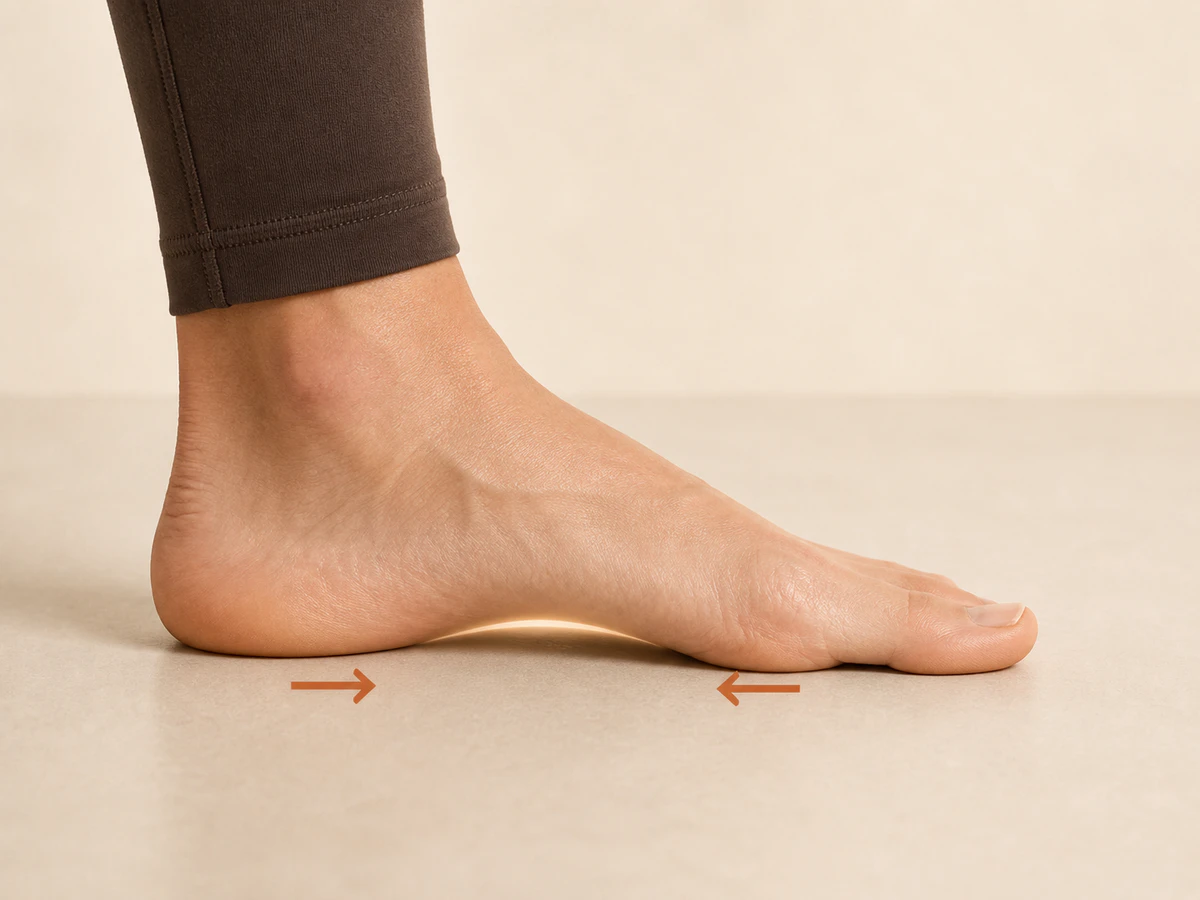
Practice the “short foot” — drawing the ball of the foot toward the heel without curling the toes — plus toe-towel scrunches. These wake up the small stabilizing muscles that take pressure off the fascia.
DailyConsistency beats intensity here. Five focused minutes twice a day, done for weeks, outperforms an aggressive session you abandon after three days. The same principle holds for the calf and tissue work we cover in our post-run recovery protocol.
How long does plantar fasciitis take to heal?
Most cases of plantar fasciitis resolve within six to twelve months with consistent care, and roughly 80 to 90 percent improve within a year. Acute cases caught early — under six weeks — often settle in a matter of weeks once loading and footwear are corrected.
The frustrating reality is the long tail. A meaningful share of cases drag past a year, and that is almost always because the loading work was never done consistently or the upstream drivers were never addressed. Time alone does not heal this; the right input over time does.
Where shockwave fits
Extracorporeal shockwave therapy (ESWT) delivers focused acoustic pulses into the painful tissue. From a biology standpoint, it does three useful things at once:
- Provokes a controlled micro-trauma that signals the body to start remodeling
- Stimulates local blood flow and growth factor release
- Reduces pain signaling at the treated site so you can start loading again
Multiple randomized controlled trials over the last fifteen years have shown that shockwave tends to outlast cortisone for chronic plantar fasciitis at the six-month mark, without the tissue effects that limit how often steroid injections can be repeated. It's also the only modality I know of that consistently helps cases that have been stuck for over a year.
When to consider shockwave therapy
Shockwave is not the right first step for everyone. Acute plantar fasciitis usually responds to the stretches, loading, and footwear changes above. Where it earns its place is the chronic, stalled case — the heel that has been hurting for three months or more and hasn't budged with diligent conservative care.
If you have done the homework honestly for six to eight weeks and the morning stab is still there, that is the signal. The same logic applies to other stubborn connective-tissue problems we see in runners, like the lateral knee pain covered in our piece on IT band syndrome — once a tissue stops responding to load management alone, it often needs a stimulus to restart the repair process. Mayo Clinic lists shockwave among the options for cases that don't respond to more conservative measures.
Heel pain has a way of surfacing right as mileage climbs — a string of long runs on the crushed limestone of the Katy Trail, or the training block that ramps toward a fall race like the MO' Cowbell Marathon. If the morning stab is showing up on the back half of your long runs, it's worth reading alongside our guides to running the Katy Trail without injury and the injuries that surface during a fall-race mileage ramp.
What a typical course looks like
Here's what we usually run patients through at The Spine Studio:
- Initial Assessment ($149). Confirm the diagnosis — about 1 in 5 "plantar fasciitis" cases is actually something else: tarsal tunnel, fat pad atrophy, or referred low-back. Identify what's loading the fascia abnormally.
- A $375 package of 3 shockwave sessions. This is the minimum recommended course for optimal tissue repair, spaced about a week apart. Each session is about twenty minutes. There's some discomfort during the treatment, none afterward.
- Daily loading homework. Heel raises off a step, slow tempo, increasing volume every week. This is the part most people skip and is the reason it works.
- Address upstream. Calf tightness, ankle dorsiflexion, hip control — whatever was making the foot work harder than it should. On a $60 follow-up visit, that means a precision spinal adjustment plus one soft-tissue modality (Pin & Stretch, Cupping & Scraping, or Corrective Exercise Programming) included at no extra charge.
Shockwave isn't the right first step for everyone. Acute plantar fasciitis (under 6 weeks) usually responds to simpler measures. Where shockwave shines is the stubborn, three-months-and-counting case that hasn't budged with conservative care.
What to do this week if your heel hurts
You don't need a clinic visit to start helping yourself. Try this for two weeks:
- Calf raises off a step, three sets of fifteen, slow. Daily.
- Foam roll your calves and the bottom of your foot for two minutes morning and night.
- Drop your running volume by 30% for ten days. Replace with biking or swimming.
- Roll a frozen water bottle under your arch only if it genuinely feels good afterward — and not as a substitute for the loading work.
If two weeks of consistent self-care doesn't move the needle, that's the signal it's time to get assessed. Plantar fasciitis is one of those conditions where a small amount of the right intervention now saves a year of frustration later.
We treat plantar fasciitis — including shockwave therapy — at our Cottleville clinic, serving O'Fallon and the wider St. Charles County area.
Find out if shockwave is right for your case.
Frequently asked questions
- How long does plantar fasciitis take to heal?
- With consistent loading and the right footwear, most plantar fasciitis settles over 6 weeks to 3 months. Stubborn cases that have lingered past three months heal more slowly on their own — that's the point where shockwave therapy often makes the difference by restarting the repair process in the tissue.
- What is the fastest way to cure plantar fasciitis?
- There's no overnight cure, but the fastest progress comes from pairing daily calf and plantar-fascia loading with activity changes — and, for chronic cases, shockwave therapy. The mistake that slows people down is total rest; the fascia needs the right amount of load to remodel, not none.
- Does shockwave therapy work for plantar fasciitis?
- Yes, especially for heel pain that has lasted more than a few months and hasn't responded to stretching and orthotics. Focused acoustic waves stimulate blood flow and the body's repair response in the fascia. Most people need a short series of sessions; we'll tell you honestly if your case is a good fit.
- Where can I get shockwave therapy for heel pain near Cottleville or O'Fallon?
- The Spine Studio offers shockwave therapy at our Cottleville, MO clinic at 5285 State Route N, serving O'Fallon, St. Peters, St. Charles and the surrounding St. Charles County area for plantar fasciitis and other stubborn tendon pain.