Achilles tendinopathy: why the pain lingers, and what rebuilds the tendon.
Rest calms an Achilles; it rarely rebuilds one. Here's why heel-cord pain drags on for months, the loading that actually reorganizes the tendon, and when shockwave restarts stalled healing.
Related guide Sports & running injuries

Achilles pain lingers because the tendon has stalled partway through repair, with disorganized collagen rather than simple inflammation, so rest calms it but rarely rebuilds it. Slow, heavy calf loading is what remodels the tendon, and many cases improve over 6–12 weeks; shockwave can restart healing when the tendon has stayed sore for months despite loading. Pain right where the tendon meets the heel needs a modified plan without step drops.
An Achilles that hurts every morning has a way of narrowing your whole life. The first steps out of bed are stiff and sore, the tendon warms up enough to fool you into a run, and then it flares worse that night. Rest helps for a week — until you go back to normal and the pain returns exactly where it was. Months pass, and the tendon is no better.
That pattern is the signature of Achilles tendinopathy, and understanding why it lingers is the key to actually fixing it.
Why does Achilles pain last so long?
The Achilles is the largest tendon in the body, connecting your calf muscles to your heel bone and taking loads of several times your body weight every stride. According to the American Academy of Orthopaedic Surgeons, it is prone to overuse problems because it has a relatively poor blood supply and takes on repetitive stress with running and jumping.
When the load you put through it outpaces its ability to repair, the tendon does not simply "inflame" — its collagen structure starts to disorganize. That is why the old label of "tendinitis" is misleading and why anti-inflammatory rest alone rarely rebuilds it. The tissue has stalled partway through repair, and it needs the right stimulus to restart, not just time off.
Mid-portion or insertional? Location changes the plan
Before treating an Achilles, you have to answer one question: where does it hurt? Squeeze the tendon a few centimeters above the heel bone — if the sore spot lives there, in the free tendon, that's mid-portion tendinopathy, the more common and more cooperative version. If the pain sits right where the tendon attaches to the back of the heel bone, that's insertional tendinopathy — and it plays by different rules.
The difference matters because the insertion is compressed against the heel bone whenever the ankle bends upward. Aggressive calf stretching and doing heel drops off the edge of a step — the classic internet advice — increase that compression and routinely make insertional cases worse. Insertional programs load the tendon through a shorter range (raises from floor level, not off a step), often with a small heel lift in the shoe early on to take the squeeze off while the tissue calms down. It's a perfect example of why "I did the exercises and got worse" usually means the right exercises for the wrong subtype.
What actually rebuilds the tendon?
The foundation is loading. A tendon remodels in response to gradual, progressive stress — not to rest. Slow, heavy calf work (both straight-knee and bent-knee, done off a step through a full range) is the single most evidence-backed way to reorganize the collagen and get the tendon carrying load again. It is uncomfortable at first, and it is supposed to be tolerable-but-not-sharp.
Where loading has stalled — the tendon that has been sore for three months and won't respond — shockwave therapy is the tool we reach for. Focused acoustic waves are thought to re-trigger the repair response and blood flow in tissue that has plateaued, which is why we pair it with loading rather than using it alone: shockwave restarts the process, the loading rebuilds the tendon.
Fresh, first-flare Achilles pain usually settles with load management and calf work. The case where shockwave earns its place is the stubborn one — months of pain that hasn't budged with conservative care. It's the same story we see with plantar fasciitis and shockwave.
Getting back to running without restarting the cycle
The mistake that keeps Achilles cases alive for years isn't the injury — it's the return. The tendon feels quiet after a few good weeks, the runner jumps back to their old volume, and the whole loop restarts. A return that holds follows rules:
- Morning stiffness is your gauge. The tendon is allowed to grumble mildly during and after a run (a 3 or less out of 10), but the next morning has to be no worse than baseline. Morning-after pain that climbs means the last session was too much.
- Add one variable at a time. Distance, pace, or hills — never two in the same week. Hills and speed work load the Achilles hardest, so they come back last.
- Keep the heavy calf work going after you're back to full mileage. The loading isn't a rehab phase you graduate from; it's what keeps the tendon's capacity above what your running demands.
One more honest flag: think hard before accepting a cortisone injection into or around an Achilles. Steroid around this particular tendon carries a known association with weakening and rupture of a structure that already takes multiples of your body weight — we walk through the trade-offs in shockwave vs. cortisone.
What to do this week
If your Achilles has been grumbling, start here before it becomes a year-long problem:
Straight-Knee Heel Raises
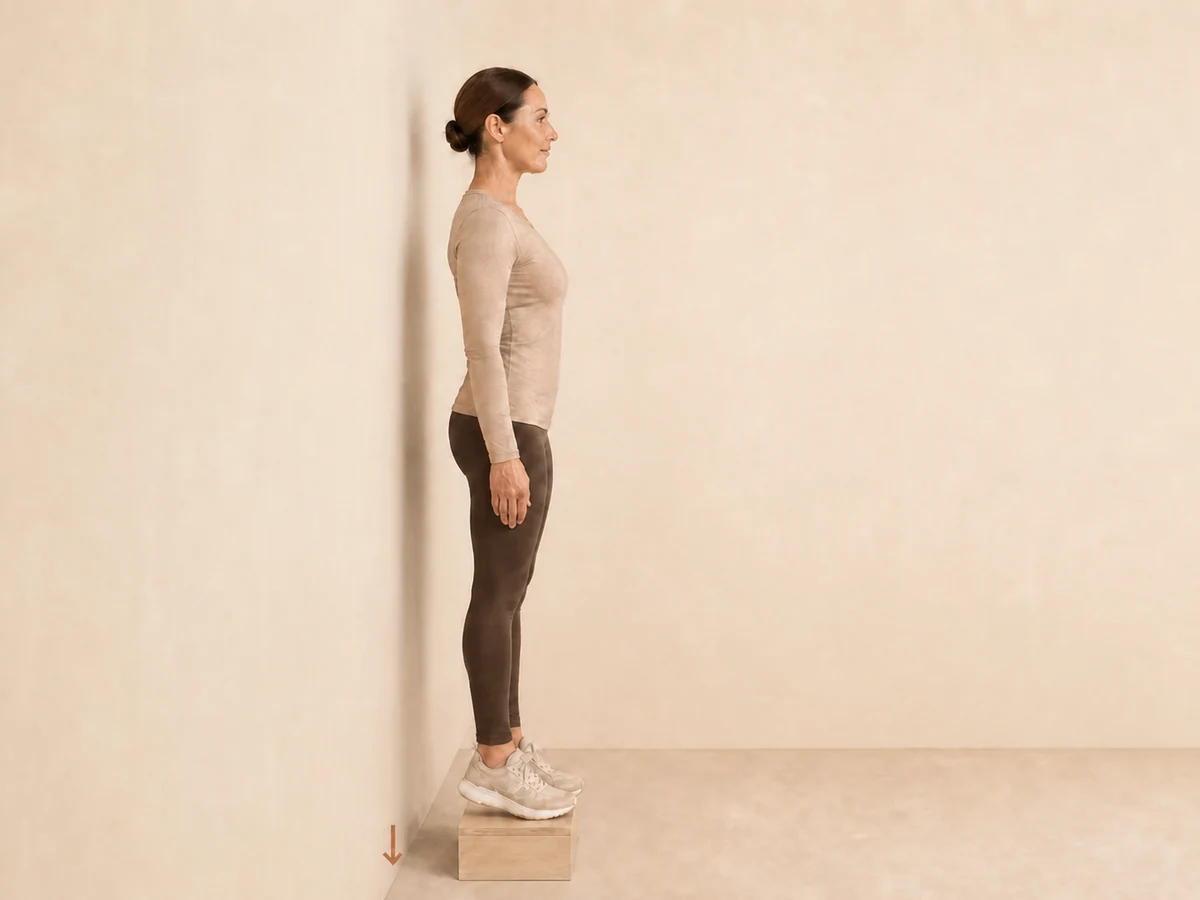
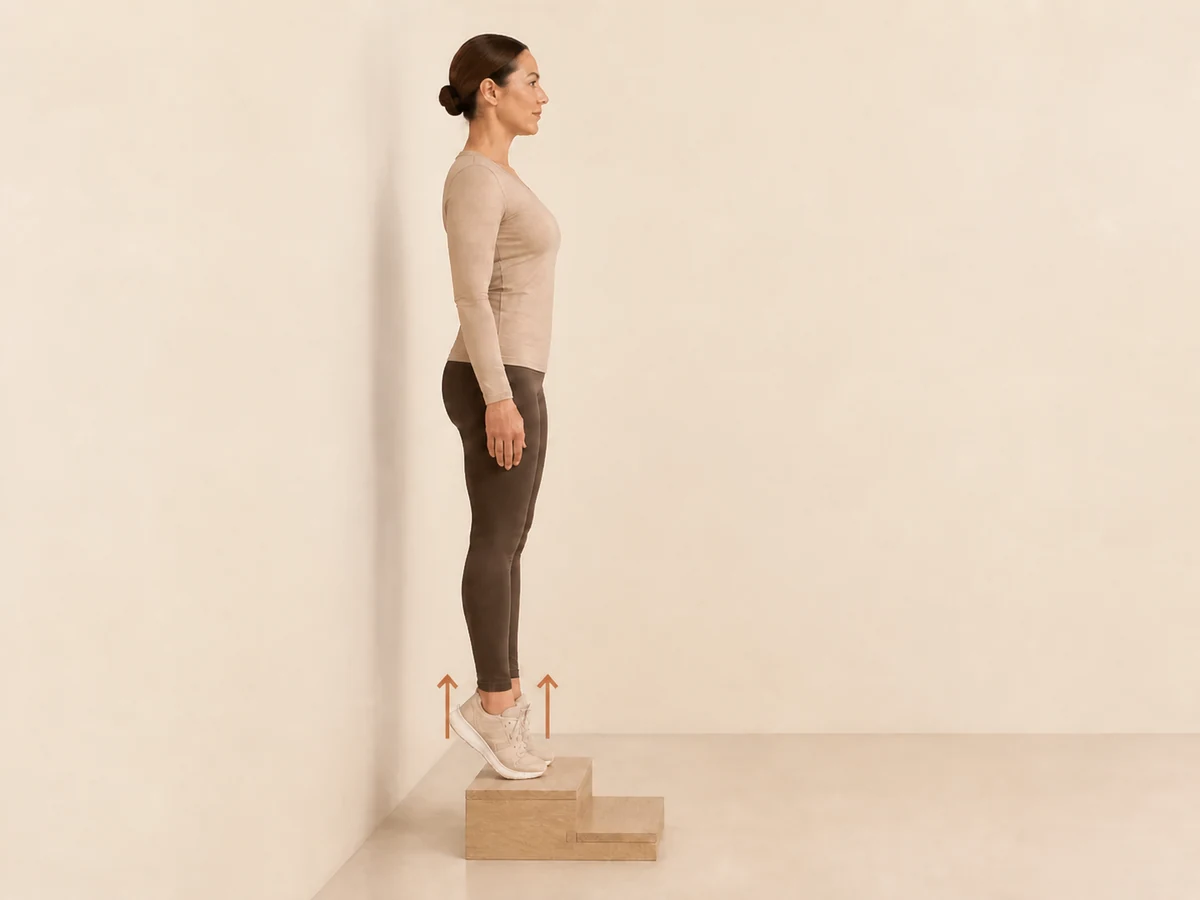
Stand on the edge of a step and slowly rise onto the balls of your feet, then lower the heels below step level. Keeping the knees straight targets the main calf muscle. Some ache during the work (up to a 3–4/10) is fine.
3 sets × 12Bent-Knee Heel Raises
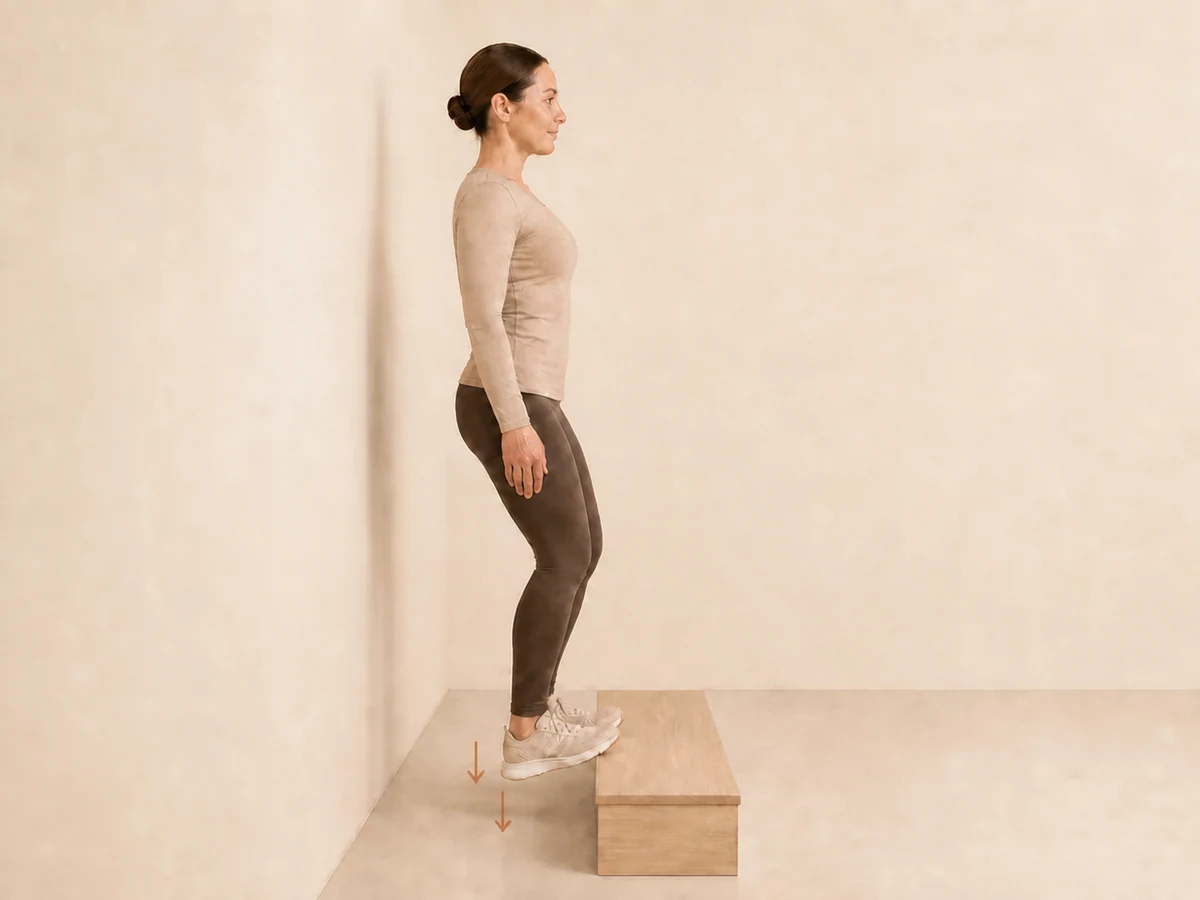
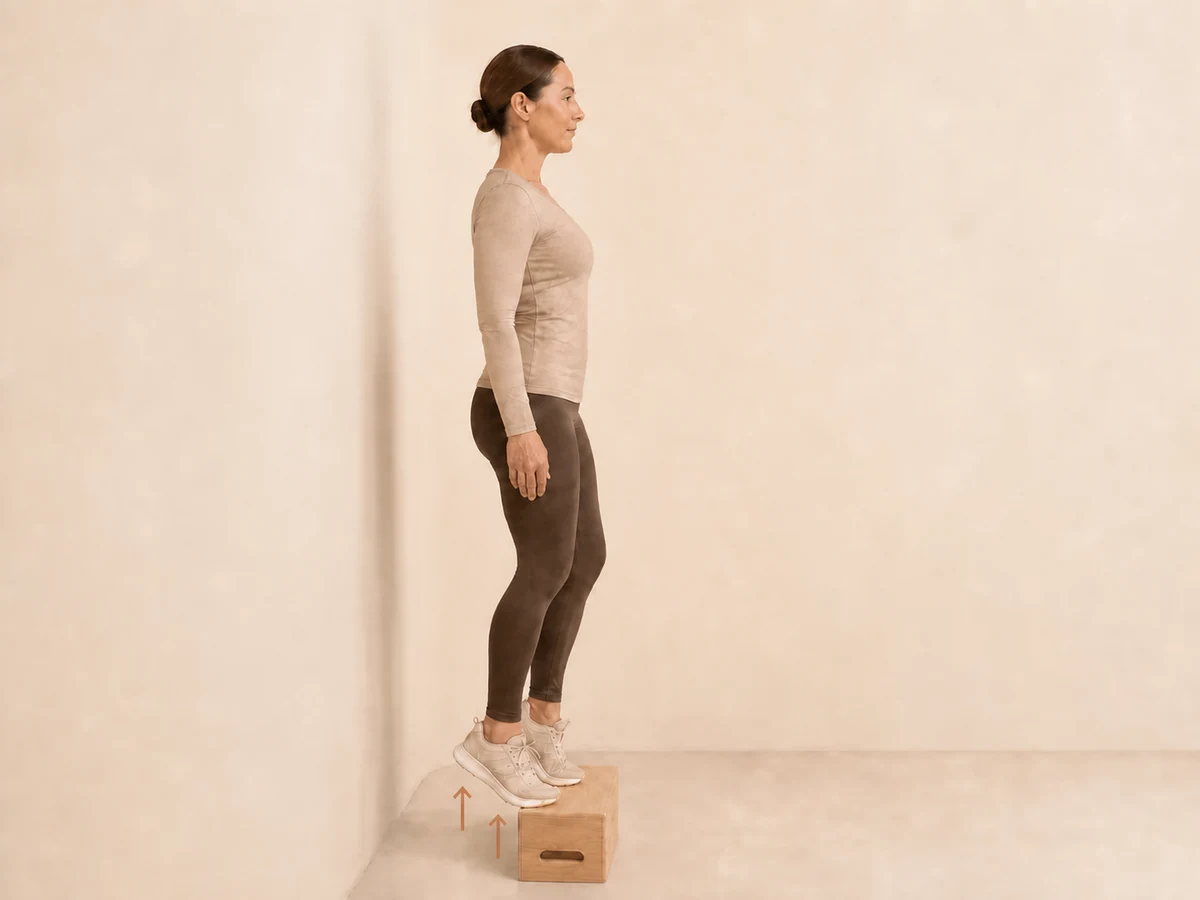
The same heel raise off a step, but with the knees kept slightly bent throughout. Bending the knee shifts the load onto the deeper soleus, which the Achilles also needs. Slow tempo.
3 sets × 12- Cut your running volume by about a third for ten days, and swap in cycling or the pool so you keep fitness without pounding the tendon.
- Avoid the temptation to fully rest — a completely rested tendon deconditions and flares the moment you return.
- Don't stretch aggressively into pain, especially with an insertional Achilles problem near the heel, where compression makes it worse.
When is Achilles pain worth getting checked?
It is worth an assessment if the pain sits right at the back of the heel, if the tendon looks swollen or thickened, if it hurts at rest and not only with running, or if it flares each time you build your running back up.
Get urgent medical care if you felt a sudden pop or a kick at the back of the ankle and now can't push off or rise onto your toes, since that can be a tear. A calf that is swollen, warm, red and tender should also be seen promptly, because it can be a blood clot.
What a visit for Achilles pain looks like
A first visit is a 40-minute assessment. Dr. Andersen asks about your running or training load and how it has changed, pins down whether the pain is mid-portion or insertional, and checks how the calf, ankle and foot are taking load. Hands-on treatment can start the same visit, and you leave with a loading plan matched to your subtype. If the tendon has stalled for months, she will talk through whether shockwave fits.
How long does Achilles tendinopathy take to heal?
With consistent loading, many cases improve over 6 to 12 weeks, though how quickly varies from person to person. A tendon that has been sore for many months, or an insertional case, often takes longer. Pain easing comes first; the tendon's strength takes longer to catch up, which is why the calf work continues after you are back to full running.
Achilles pain and the St. Charles County running calendar
Around Cottleville and St. Charles County, the Achilles cases we see tend to cluster on a calendar. The Katy Trail draws a steady crowd of long-run milers, and every late summer the training blocks for fall races — the MO' Cowbell among them — push weekly volume upward in a hurry. That ramp is where "too much too soon" lives: a runner comfortable at twenty miles a week stacks on distance, hills, and pace all at once to hit a goal date, and a tendon that had been quiet starts grumbling by the first cool mornings. The flat, forgiving crushed limestone of the Katy Trail is kind to the joints, but mileage is still mileage — the tendon only cares about total load and how fast it climbed.
The fix isn't skipping the race; it's respecting the ramp. If you're building toward a fall date and the Achilles is already talking, hold the weekly jump modest, keep the heavy calf work in through the whole block, and add hills or speed on their own weeks rather than piling them together. We've written separately about running the Katy Trail without injury and the training injuries that surface during MO' Cowbell season, and the same principle runs through both: the tendon can carry a big block, but only one you build into gradually.
If two weeks of consistent loading doesn't change the morning stiffness, that's the signal to get assessed. As a sports chiropractor in Cottleville, we treat Achilles tendinopathy — including shockwave therapy in Cottleville — and pair it with the loading plan that actually rebuilds the tendon. Recovery after training matters too; here's how to recover well between runs.
Stubborn Achilles pain that won't quit? Let's find out if shockwave fits.
Frequently asked questions
- How long does Achilles tendinopathy take to heal?
- With consistent loading, many cases improve over 6 to 12 weeks, but a tendon that's been sore for months can take longer. The biggest mistake is total rest — the tendon needs progressive load to remodel. For stalled cases, shockwave therapy often restarts progress that loading alone hasn't.
- Does shockwave therapy work for Achilles tendinopathy?
- It's most useful for chronic cases — pain that's lasted more than a few months and hasn't responded to calf loading and activity changes. Focused acoustic waves are thought to re-trigger the repair response in stalled tendon tissue. We pair it with a loading program, because shockwave restarts healing and loading rebuilds the tendon.
- Should I rest completely if my Achilles hurts?
- No. Complete rest deconditions the tendon and it flares the moment you return to activity. The better approach is relative rest — reduce the aggravating load, keep fitness with low-impact cross-training, and do slow, progressive calf work that the tendon can tolerate.
- What's the difference between Achilles tendinitis and tendinopathy?
- 'Tendinitis' implies active inflammation, which is why rest and anti-inflammatories were the old default. Chronic Achilles pain is usually tendinopathy — a breakdown and disorganization of the tendon's collagen rather than simple inflammation, which is why it responds to loading and shockwave rather than to rest alone.